
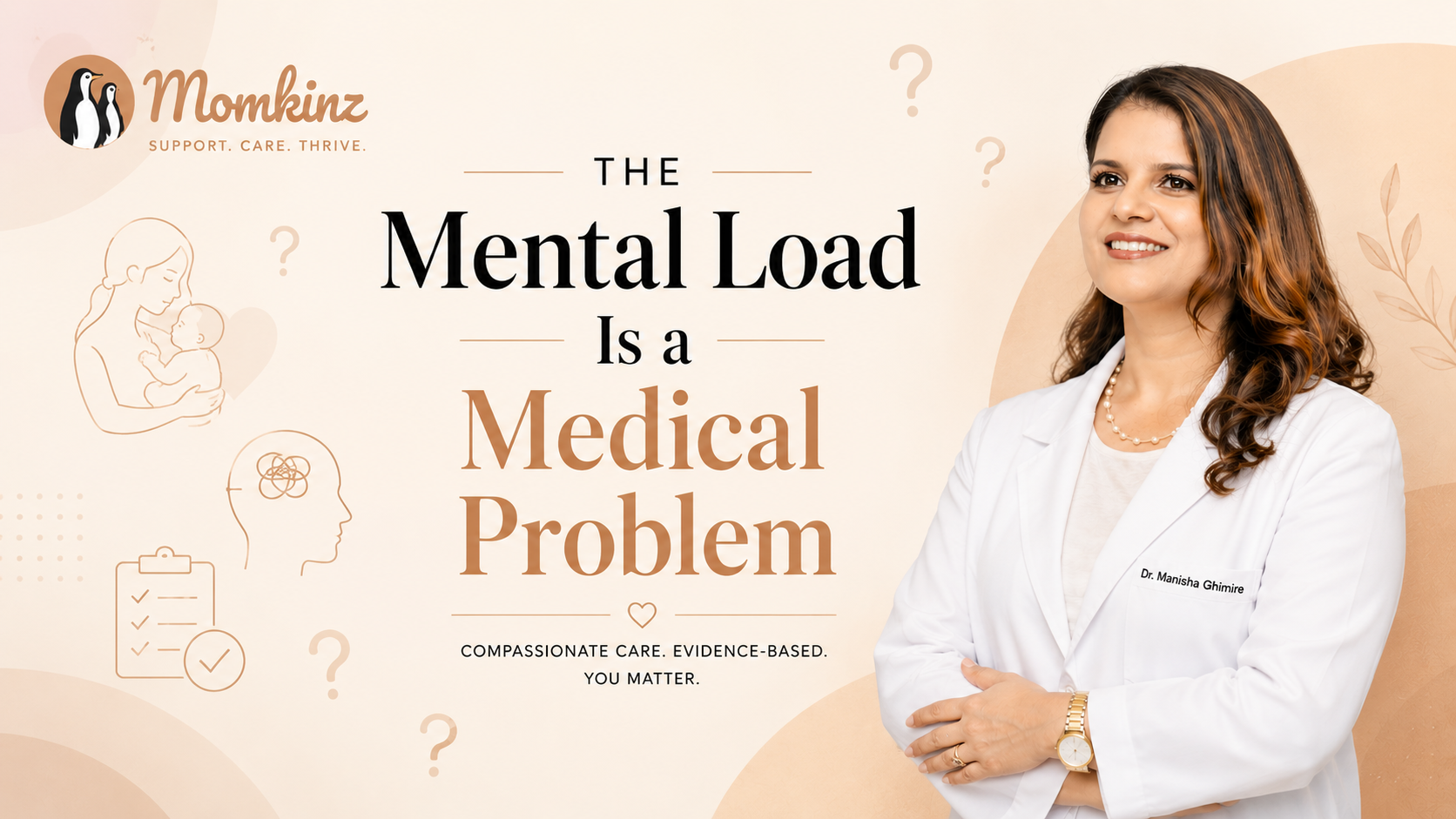
I want to start with a question no one ever asks at a doctor’s visit.
Not “how many hours of sleep are you getting?” Not “what does your diet look like?” Not even “how are you feeling emotionally?” — though that one is rare enough.
The question I want to ask is this: How many tabs do you have open right now? Not on your computer. In your mind.
The dentist appointment that needs to be rescheduled. The birthday gift that has not been ordered. The teacher’s email that requires a response. The permission slip. The meal plan for the week. The medication that is running low. The friend who is going through something and needs checking on. The work deadline sitting in the background. The thing your child said last week that you have been quietly worrying about ever since.
How many? Take a moment. Actually count.
That count — that exact number — is clinical information. Because what you are carrying in your mind at any given moment has a direct, measurable, documented effect on the body you live in. And the healthcare system has almost no framework for talking about it.
The Invisible Load No One Has Named Correctly
We talk about the mental load as though it is an organizational problem. A fairness problem. A conversation to have with your partner about who does what. And it is all of those things. But it is also something else entirely — something that most of the conversations about the mental load never get to.
It is a chronic physiological stressor.
Every open loop in your mind — every unresolved task, every pending decision, every responsibility you are tracking without a system to hold it — generates a low-grade demand on your nervous system. Not as large as an acute crisis. But constant. Unbroken. Never fully resolved before the next one opens.
Researchers call this cognitive residue. The brain does not simply set aside an unfinished task when you move to the next one. It keeps a portion of its processing allocated to the incomplete item — monitoring it, returning to it, bracing for the moment it becomes urgent. For a mother carrying dozens of these open loops simultaneously, the cumulative cognitive and neurological burden is enormous.
And the body responds to that burden the same way it responds to any sustained threat: with cortisol.
What the Research Actually Shows
The link between cognitive overload and cortisol elevation is well-established in the occupational health literature — studied in air traffic controllers, emergency physicians, and executives managing high-stakes complexity. What is less studied, and far less cited, is that most mothers are operating under cognitive demands that rival or exceed these high-stress professions, without the professional support structures, the defined shift hours, or the social recognition that those roles carry.
Chronically elevated cortisol is not a minor inconvenience. Here is what it does in your body over months and years:
It redistributes fat.
Cortisol specifically drives visceral fat accumulation — the metabolically active fat stored around the organs in the abdomen. This is the fat most associated with cardiovascular disease, type 2 diabetes, and inflammatory conditions. The weight that arrives around your middle and won’t move regardless of what you eat is often not a nutrition problem. It is a cortisol signature.
It degrades sleep quality.
Even when you have the opportunity to sleep, chronically elevated cortisol disrupts the sleep architecture — cutting into the slow-wave deep sleep and REM cycles that perform the actual restoration. You can sleep eight hours and wake exhausted because the sleep was shallow, fragmented, and lacking the restorative phases your body needs. The exhaustion that sleep does not fix is frequently a cortisol problem.
It impairs immune function.
The immune system’s regulatory work — the surveillance, the repair, the inflammatory modulation — is suppressed under chronic cortisol elevation. Mothers who are sick more often than they used to be, who take longer to recover, who feel run down for weeks after a minor illness, are often experiencing the immune consequences of sustained cognitive overload.
It reshapes the brain.
This is perhaps the most sobering finding. Chronic stress physically alters brain structure — shrinking the hippocampus (memory and emotional regulation) and enlarging the amygdala (threat detection and fear response). The brain fog, the difficulty concentrating, the feeling that you used to be sharper than you are now — these are not imagined. They are the neurological result of a brain that has been operating under sustained threat-level demand for too long.
Why Mothers Are Uniquely Vulnerable
The mental load is not distributed equally. Research consistently shows that in heterosexual partnerships, women carry a disproportionate share of the household’s cognitive management — not just the tasks, but the awareness of what needs to happen, the monitoring of progress, the anticipation of future needs, and the emotional regulation of everyone involved.
This is true whether the mother works full-time, part-time, or not at all. The paid work changes. The mental load largely does not.
And crucially: it does not stop. There is no shift change for the family’s cognitive manager. There is no end of the workday, no weekend, no vacation during which the mental tabs close. The mother who goes to sleep thinking about what needs to happen tomorrow and wakes up already running through it is not anxious. She is operating exactly as her role has trained her to operate. The problem is that her nervous system cannot tell the difference between a high-demand cognitive role and an active threat. It responds to both with the same chemistry.
The Moment It Becomes Visible
What concerns me most as a physician is the moment the mental load becomes visible — because by then, it has usually been invisible for years.
It becomes visible as a diagnosis: hypertension at 38. Insulin resistance at 41. Autoimmune flare after a period of extraordinary stress. A panic attack in a grocery store, seemingly from nowhere. Major depressive episode. These are not random events. They are the body finally sending a signal that can no longer be ignored after years of quieter signals that were.
It becomes visible in the body: the persistent neck and shoulder tension no massage fully releases. The gut that has been off for years. The skin that flares when life gets heavy.
The hair that has been thinning. These are tissue-level records of a nervous system that has been running at capacity for too long.
It becomes visible in the relationship: the irritability that has replaced the warmth. The distance that has opened quietly. The mother who is physically present and emotionally unavailable — not because she does not care, but because there is nothing left after the cognitive labor of caring for everything else.
What Actually Helps: It Is Not What You Think
The standard response to mental load conversations is task redistribution. Share the list. Have the conversation. Create a fair division. And yes — that matters, and that conversation is worth having.
But redistribution alone does not address what has already accumulated in the body. The cortisol that has been building for years does not resolve because this week’s task list was more evenly divided. The sleep architecture that has been disrupted does not repair overnight. The brain that has been altered by chronic stress requires more than a cleaner calendar to restore itself.
This is why the work I do with mothers through the CLEAR Method begins not with the task list but with the body. With the nervous system. With the physiological state that the invisible load has created — because until that state is addressed, nothing else changes in a way that lasts.
Calming the nervous system first. Lifting metabolic awareness so you understand what your body is actually experiencing. Eliminating invisible overload — not just redistributing it, but genuinely reducing it. Aligning routines to work with your biology rather than against it. And then, and only then, reclaiming the identity that has been quietly buried under years of managing everything for everyone else.
The mental load is not a scheduling problem. It is a health problem. And it deserves a health solution — one that starts in the body, not the calendar.
A Note to the Mother Who Just Recognized Herself
If you read this and felt the specific discomfort of recognition — if some part of you thought this is me, this is exactly what is happening — I want you to know something.
The fact that you have been carrying this without it being named, without it being recognized as the physiological burden that it is, is not evidence that you should be able to handle it. It is evidence that the systems around you have failed to see it.
I see it. I built Momkinz because I see it.
And the first step toward anything different is exactly what you just did: letting it be named.
Ready to Stop Managing the Load and Start Addressing It?
- Download the Free Mom Checklist — a structured tool for mapping where your cognitive energy is actually going.
- Read about the CLEAR Method — the five-step framework built specifically for the mother carrying the invisible load.
- Join the Group Coaching Program — a cohort of mothers working through the CLEAR Method together, with physician-informed support at every step.
- Reach out directly — sometimes the most important first step is simply telling someone the truth about what you are carrying.
Dr. Manisha Ghimire is a board-certified physician, obesity medicine specialist, and the founder of Momkinz. Momkinz is a coaching platform, not a medical practice. This content is educational and does not constitute medical advice, diagnosis, or treatment.